
TL;DR
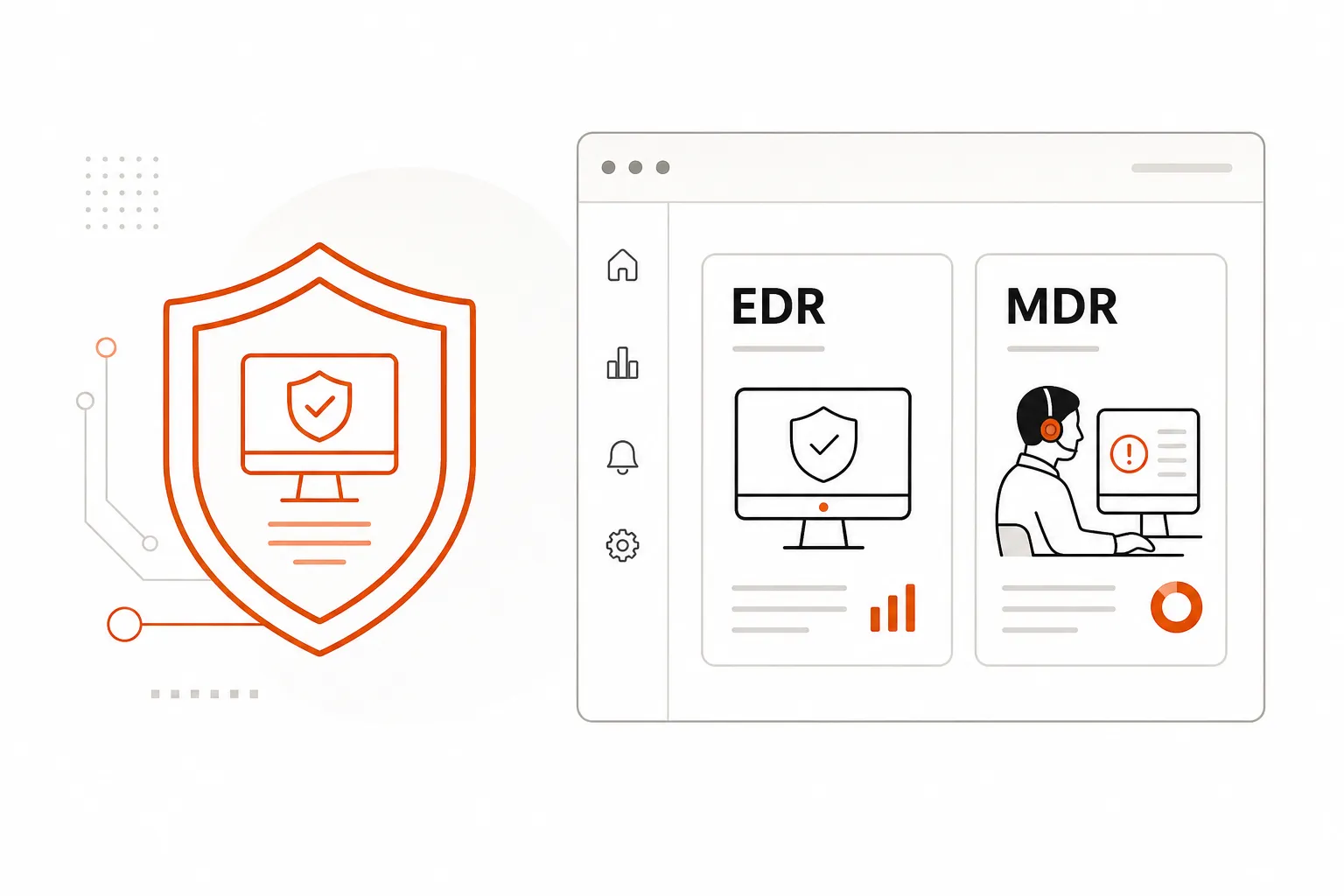
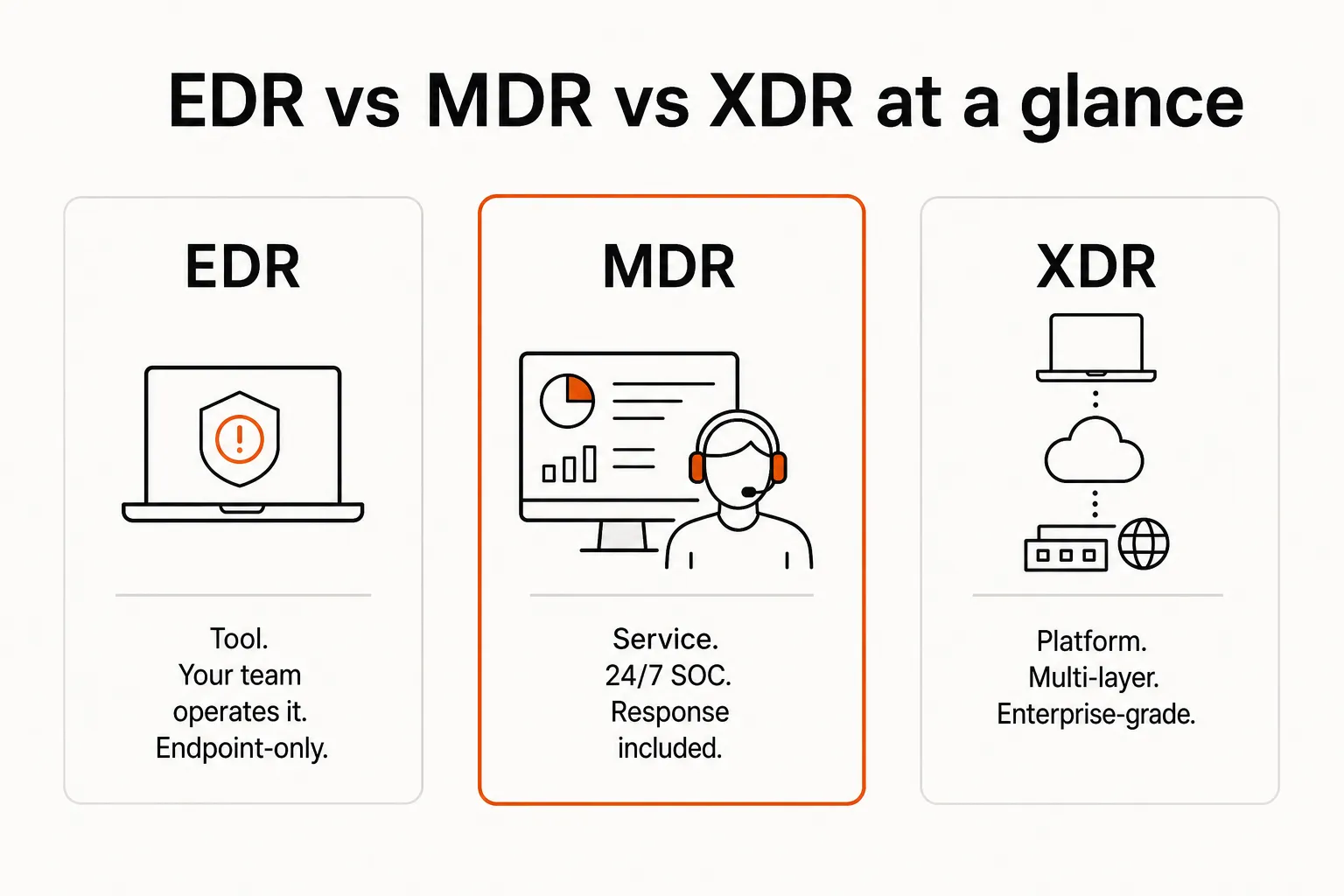
EDR is a tool your team operates. MDR is a service where a third-party SOC does the monitoring and response for you. Most MSPs deploy EDR to all customers and layer MDR on top for anyone who can't afford alert fatigue or a breach. XDR is enterprise-grade - relevant for your top 5% by revenue. The typical MSP sweet spot in 2026: EDR to everyone, MDR to regulated or high-risk customers, and an AI technician like Rallied to keep the L1 ticket queue from choking your team while the security stack does its job.
If you've been in an MSP sales conversation lately, you've probably hit this moment: the prospect leans forward and says, "So we need MDR, right? Not just EDR?" And you either nodded along or found yourself reaching for a whiteboard.
The alphabet soup is real. EDR, MDR, XDR - the security market generates acronyms faster than threat actors generate Cobalt Strike beacons. But the underlying question matters, because getting the answer wrong in either direction costs real money: under-buy and your customers get breached; over-buy and you're reselling a product nobody's budget can actually absorb.
We've spent time with the research on this - across the actual pricing pages, the r/msp threads where people aren't being polite, and the vendor G2 reviews that tell you what the sales deck leaves out. Here's the honest breakdown.
What EDR actually is (and what it isn't)
Endpoint Detection and Response is a software agent that lives on your endpoints - laptops, desktops, servers - and watches what they're doing in real time. Process execution chains, registry modifications, network connections, file activity. When something looks suspicious, the agent surfaces it for investigation.
The key word is your team. EDR is a tool. It detects; humans (or preconfigured playbooks) respond. If you deploy SentinelOne or CrowdStrike Falcon Go and walk away, you now have a very expensive alerting system that nobody's watching. That's not a security posture - that's a compliance checkbox waiting to get violated.
What EDR does well:
- Behavioral analytics on the endpoint (catches what signature-based AV misses)
- Persistent foothold detection - the attacker who's been quietly living in your customer's environment for three weeks
- Process-level forensics for incident investigation
- Ransomware canaries (honeypot files that trigger early warning)
- Tamper protection to prevent an attacker from killing the agent
What EDR doesn't do:
- Monitor 24/7 for you. It collects telemetry; you or a vendor analyze it.
- Replace antivirus. Huntress bundles free managed AV specifically because people keep thinking their EDR covers this.
- Patch systems, deploy software, or enforce configuration baselines. You still need an RMM.
- Handle identity threats or cloud infrastructure. That's a different layer.
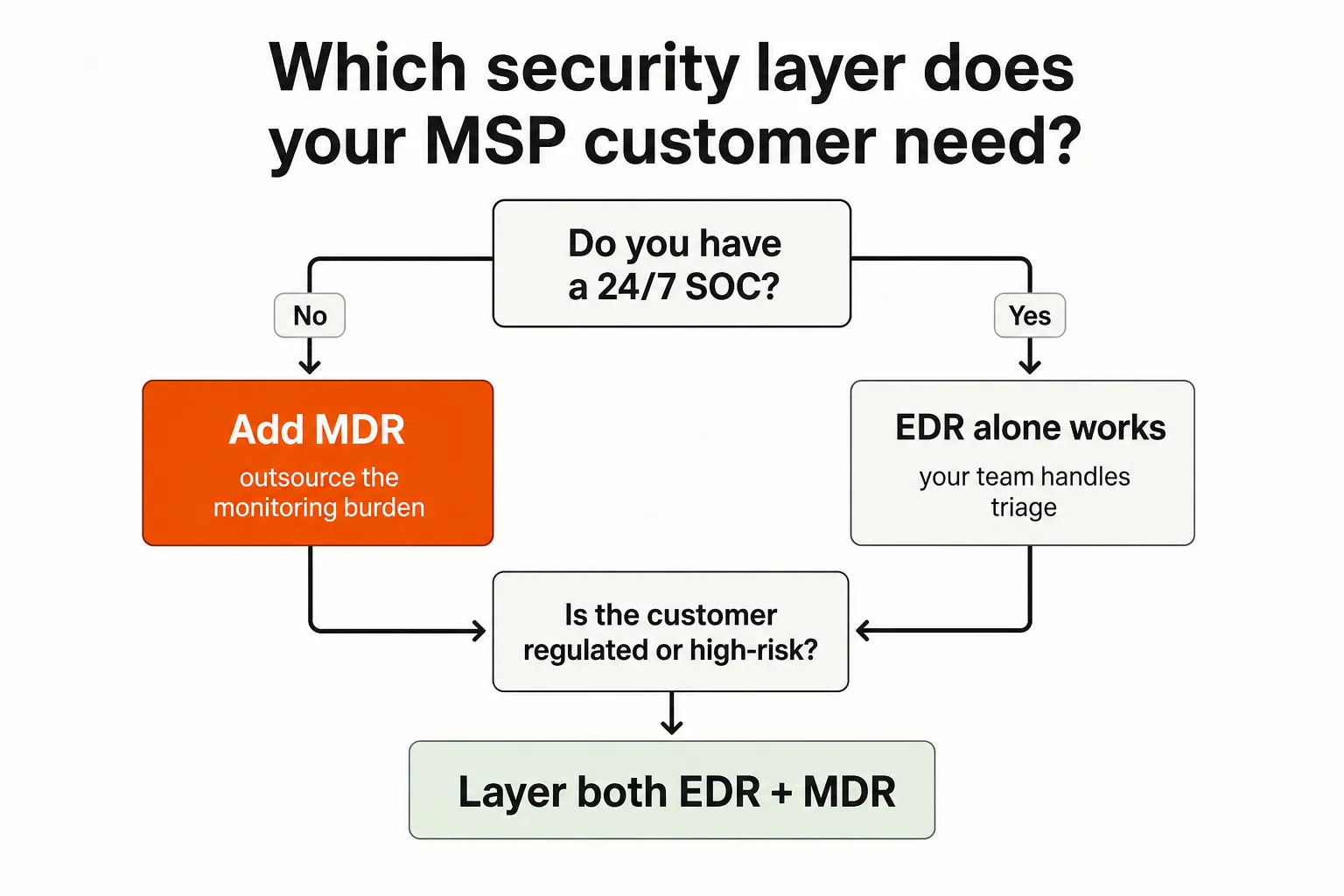
The pricing reality: self-managed EDR runs roughly $3–$15 per endpoint per month depending on the vendor and tier. CrowdStrike Falcon Go starts at $7.99/endpoint/month. SentinelOne Core starts at $69.99/endpoint/year (~$5.83/month). Huntress Managed EDR runs $8.99/endpoint/month direct, but MSP partners typically get it at $2–$4.50/endpoint/month - meaningfully different math.
What MDR actually is (and what it changes)
MDR is a service, not a product. A vendor operates a 24/7 Security Operations Center staffed with analysts who monitor your customer environments, investigate every suspicious event, and respond - isolating devices, removing malware, closing the incident - without waiting for your team to get paged at 2am.
The value proposition is brutally simple: most MSPs don't have a SOC. Running one costs $50K–$150K+ per analyst per year, minimum two people for 24/7 coverage. MDR outsources that entirely, at a fraction of the cost.

What you get with MDR:
- 24/7 human-led monitoring and triage (actual analysts, not just automation)
- Threat investigation depth - understanding what happened, not just that something happened
- Active remediation - device isolation, malware removal, reversing persistence mechanisms
- Incident reporting and forensic documentation
- Breach response warranty at many vendors ($500K–$2M coverage if something gets through)
The nuance: MDR is often built on top of an EDR tool. Huntress Managed EDR is essentially their EDR agent plus a 24/7 SOC. CrowdStrike Falcon Complete is Falcon EDR plus their managed response team. You're not choosing between EDR and MDR in those cases - you're choosing whether to staff the response layer yourself or pay someone else to do it.
MDR pricing: expect $8–$25 per endpoint per month at direct/retail rates. MSP channel pricing varies considerably - Huntress's MSP partner program typically yields ~50% off, putting it at $2–$5/endpoint/month at volume. Blackpoint Cyber doesn't publish pricing and requires a demo conversation, which tells you something about where they sit in the market.
EDR vs MDR vs XDR: the grid
| EDR | MDR | XDR | |
|---|---|---|---|
| What it is | Software tool | Managed service | Unified platform |
| Scope | Endpoints only | Endpoints (+ sometimes cloud/identity) | Endpoint + network + cloud + identity |
| Who monitors it | Your team | Vendor's 24/7 SOC | Your team or optional MDR service |
| Response | You or playbooks | Analysts act on your behalf | Automated + optional analysts |
| Pricing (direct) | $3–$15/endpoint/mo | $8–$25/endpoint/mo | $15–$40/endpoint/mo |
| Best for | MSPs with internal security staff | MSPs without a SOC | Enterprise/large MSP top tier |
| Vendor examples | SentinelOne, CrowdStrike Falcon | Huntress, Blackpoint Cyber, Sophos MDR | SentinelOne Singularity, CrowdStrike Falcon Complete XDR |
XDR is the natural next step after MDR if your customer's threat surface has expanded beyond endpoints into cloud workloads, Entra ID, and network infrastructure - all of which need correlating. The MITRE ATT&CK evaluation results for SentinelOne Singularity (100% detection rate, 88% less noise than competitors) are legitimately impressive. But enterprise pricing and implementation complexity put it out of reach for most SMB clients. For the 90%+ of MSP customers sitting below 500 endpoints, EDR + MDR is the stack.
What the MSP community actually does
The Reddit r/msp consensus, synthesized from multiple threads: deploy EDR to everyone, add MDR for customers who can afford it or who have compliance requirements that demand evidence of 24/7 monitoring.
"We use EDR for customers with $5M+ in IT spend. Smaller customers can't afford the [MDR] premium, so we do best-effort alerting."
That's honest, and it describes most of the market. The problem is "best-effort alerting" on an EDR tool with no SOC isn't really a security offering - it's a checkbox. The moment something actually lands, you're doing incident response on your own time at 3am.
The Huntress r/msp AMA thread (250+ comments) is worth reading if you haven't. The sentiment is consistent: Huntress works because they don't spam. When you do get an alert, it's real. The 8-minute MTTR stat isn't marketing copy - it comes from the SOC already doing the investigation before you see the notification.
"During the trial we made enough money in saved incidents to pay for Huntress for three months - it paid for itself in two days." - r/msp community member
Blackpoint Cyber occupies a similar niche, with a different emphasis: they position on the claim that traditional EDR misses 72% of attacks and that their SOC detects and responds before the alert even fires. Their G2 rating is 4.7/5 across 258 reviews, with 86% five-star. The partner community is vocal about them actually picking up the phone.
"Blackpoint is not a vendor; they are a true partner. When we need something, they bend over backwards more than anyone else in our stack." - Shawn Fox, CRO, Premier One, via Blackpoint Cyber testimonials
For a deeper look at how Huntress and Blackpoint compare, we wrote a dedicated breakdown here.
The five questions that tell you which one your customer needs
Not every MSP customer needs the same stack. The decision tree comes down to five things:
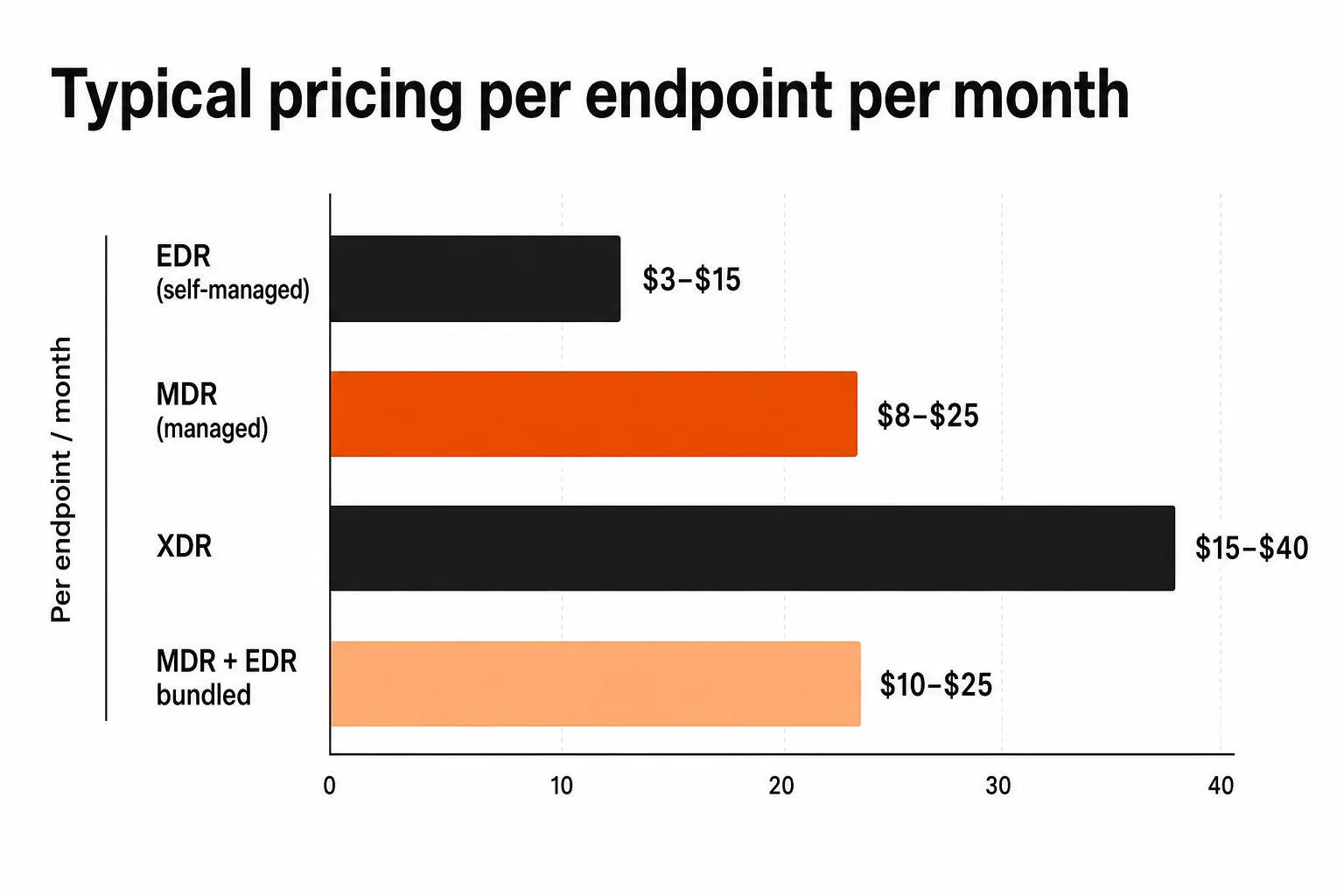
1. Does your MSP have a 24/7 SOC?
If yes: EDR alone can work - your team handles triage and response. If no: you need MDR, or you have a gap you're probably not acknowledging to your customers.
2. How many endpoints does the customer have?
Under 50 endpoints: EDR is viable, MDR is a harder sell on pure ROI (though still worth it for high-risk industries). 100–500 endpoints: EDR + MDR is increasingly table-stakes. 500+: you should have this conversation.
3. Are they in a regulated industry?
Healthcare, finance, legal - these customers need documented evidence of active monitoring and response. "We deployed an EDR tool" doesn't satisfy HIPAA auditors. MDR gives you the SOC logs, incident reports, and response documentation compliance requires.
4. What's their ransomware exposure?
High-value targets, internet-facing infrastructure, M365 with shared credentials? The Blackpoint Cyber stat that 20% of newly onboarded organizations already have business email compromise hiding in their environment at signup is not exaggerated. For customers where a successful ransomware hit could be catastrophic, MDR's breach warranty and rapid response time are worth the premium.
5. What can they actually afford?
Be honest here. At $2–$5/endpoint/month with MSP pricing, Huntress MDR on a 100-seat customer runs $200–$500/month. That's a line item most businesses can absorb. At $15–$25/endpoint/month, you're having a different conversation.
The pricing reality (not the sticker price)
The sticker prices are mostly noise for MSPs. What matters is your channel rate.
| Product | Direct (per endpoint/mo) | Typical MSP rate | Notes |
|---|---|---|---|
| CrowdStrike Falcon Go (EDR) | $7.99 | Contact sales | 100-device max on Go tier |
| CrowdStrike Falcon Complete (MDR) | Contact sales | Contact sales | Fully managed, enterprise-oriented |
| SentinelOne Core (EDR) | ~$5.83 | Varies | Annual pricing |
| SentinelOne Wayfinder (MDR) | ~$10–$15 | Varies | 3.3-minute detection-to-triage |
| Huntress Managed EDR | $8.99 | ~$2–$4.50 | Channel-first, ~50% discount |
| Huntress ITDR (identity) | $4.80/identity | ~$2.40 | M365 + Google Workspace |
| Huntress SIEM | $4.00/source | ~$2.00 | Smart filtered model |
| Blackpoint Cyber MDR | Not published | Contact sales | 1-month average implementation |
| Sophos MDR + Intercept X | ~$18–$19/year | Partner pricing | Bundle includes both EDR + MDR |
For the math to work on an SMB customer at, say, 80 endpoints with Huntress MSP pricing: ~$360/month for EDR + MDR. You're reselling peace of mind, 24/7 coverage, and a breach warranty for a line item that's smaller than their Microsoft 365 subscription. That's a serviceable pitch.
The Huntress small MSP example tells the broader story: 200 endpoints + 100 identities at MSP rates runs $1,140–$1,250/month. Compared to a part-time SOC analyst at $2,500/month (generous estimate), Huntress wins on cost and coverage depth.
What MSPs get wrong about this decision
"We deployed EDR, we're covered."
No. Deploying EDR without anyone monitoring and responding to alerts is like installing a CCTV system and not watching the footage. The tool collects evidence; humans stop the threat. If your team can't staff 24/7 triage, you need MDR.
"MDR is just expensive EDR."
Sort of - in that MDR typically runs on top of an EDR agent. But you're not paying for extra software. You're paying for certified analysts, 24/7 availability, institutional knowledge of attacker TTPs, and breach response. The skill gap in the security market is real: the global shortage of cybersecurity professionals is projected to hit 3.5 million unfilled positions in 2025. MDR is how you access that expertise without hiring for it.
"XDR is the upgrade path from EDR."
Not quite. XDR is a different scope, not a better version of EDR. It adds network, cloud, and identity telemetry to the endpoint layer - valuable when your threat surface has grown to match. For most MSP SMB customers, the endpoint is the threat surface. EDR or MDR covers it. XDR is overkill until you're protecting multi-cloud enterprise workloads.
"Small customers don't need any of this."
Ransomware groups don't screen by company size. A 12-person dental office with an unpatched Windows Server and M365 shared credentials is an easy target. The question isn't whether they need protection - it's whether they can afford the right tier. EDR at $3–$5/endpoint/month is defensible for an SMB that can't stretch to MDR. "Nothing" is not a tier.
The MDR vendor landscape for MSPs
For MSPs choosing an MDR partner, these are the players that actually show up in r/msp conversations:
Huntress - 4.8/5 on G2 across 1,200+ reviews, 99% satisfaction score, 97% would recommend. Purpose-built for the MSP channel. Transparent pricing, no feature gating, 24/7 SOC included. Best for MSPs in the 50–500 endpoint range who want a managed security layer they can actually sell.
Blackpoint Cyber - 4.7/5 on G2 across 258 reviews. MSP-first positioning. Strongest differentiator is the claim of detecting and responding before the alert fires. No public pricing; demo-led sales. Best for MSPs wanting a true partner relationship and willing to engage a more involved sales process.
Sophos MDR - 4.7/5 on G2 across 498 reviews. Full bundle (Intercept X EDR + MDR Complete) at ~$215–$230/endpoint/year makes the math cleaner. Strong channel program and multi-tenant console. Best for MSPs already in the Sophos ecosystem or wanting one vendor for both layers.
CrowdStrike Falcon Complete - The enterprise-grade option. Falcon Complete MDR is the fully managed version of the industry-leading Falcon platform. 7-time Gartner MQ Leader for Endpoint Protection. Premium pricing, premium outcomes. Best for MSPs serving enterprise customers where the name recognition matters in a board conversation.
SentinelOne Wayfinder MDR - Built on the Singularity platform (5-year Gartner MQ Leader), with a claimed 3.3-minute average detection-to-triage time and $1M breach response warranty. Best for MSPs positioning security as a differentiator and willing to pay for best-in-class detection metrics.
We went deeper on two of these in Huntress vs Blackpoint Cyber: Which MDR Is Right for Your MSP in 2026?
Where EDR and MDR don't help you (and what does)
Here's the thing neither vendor will put on their pricing page: EDR and MDR are your security layer. They watch for breaches. They don't run your service desk.
The average MSP handles 200–400 tickets a month that have nothing to do with security incidents - password resets, account unlocks, MFA lockouts, new hire provisioning, license management. While your security stack is busy watching for ransomware, your technicians are doing those tickets by hand. At 15 minutes each, that's 50–100 hours per month of L1 labor on work that doesn't require a human.
That's a Rallied problem, not a Huntress problem.
Rallied is an AI technician built for MSPs that connects to your PSA (ConnectWise, Autotask, Halo PSA, SuperOps), RMM (Datto, NinjaRMM), and identity systems (M365, Entra ID, Okta, JumpCloud) and resolves those tickets autonomously - resets the password, unlocks the account, handles the onboarding request - without a human touching it. Deploys the same week, $0.50/ticket, no implementation overhead.
Your security stack (EDR + MDR) keeps the network safe. Rallied keeps the L1 ticket queue from burying your technicians. They don't overlap; they stack.

Try Rallied
If your team is spending hours on password resets and account unlocks while your MDR stack watches for actual threats, Rallied is worth a look. It connects to the MSP stack you're already running, deploys in a week, and starts resolving L1 tickets before your trial ends.
The math is straightforward: 500 tickets/month at $0.50 each = $250/month. At $150/hr billable rate, that's $7,500+ in tech time back every month.
The ThreatLocker vs CrowdStrike post covers the complementary question of prevention-first vs detection-first security stacks if you're thinking through the full picture.
Frequently Asked Questions
What is the main difference between EDR and MDR?
EDR (Endpoint Detection and Response) is software your team operates. It monitors endpoints and surfaces threats, but your people handle triage and response. MDR (Managed Detection and Response) is a service - a third-party SOC monitors your environment 24/7, investigates alerts, and responds on your behalf. MDR is essentially EDR plus the human layer.
Do MSPs need MDR, EDR, or both?
Most MSPs serving SMB customers deploy EDR to everyone and add MDR for customers who want 24/7 monitored response, have compliance requirements, or are high ransomware-risk. Small customers on thin budgets often get EDR-only. Mid-market customers ($100–$1,000 endpoints) are increasingly asking for MDR as a baseline. See our Huntress vs Blackpoint Cyber comparison for two strong MSP-focused MDR options.
How much does MDR cost per endpoint per month?
Direct pricing typically runs $8–$25 per endpoint per month for MDR, depending on the vendor and service level. MSPs with channel agreements (like Huntress) often pay 40–50% less - closer to $2–$5 per endpoint. EDR alone runs $3–$15 per endpoint per month. XDR is generally $15–$40, targeting enterprise.
What is XDR and does my MSP need it?
XDR (Extended Detection and Response) is a multi-layer detection platform that aggregates data from endpoints, networks, cloud infrastructure, and identity - catching attacks that hop across layers. Most MSPs serving SMBs don't need it yet; EDR + MDR covers 90%+ of the threat surface. XDR is more relevant for MSPs serving enterprise customers with complex multi-cloud environments.
Can Rallied replace MDR for my MSP?
Rallied and MDR solve different problems. Rallied is an AI technician that autonomously resolves L1/L2 tickets - password resets, account unlocks, onboarding - saving 50–100 hours of tech time per month. MDR is a security service monitoring for threats and responding to incidents. You'd typically run Rallied alongside your MDR stack, not instead of it.