
TL;DR
Most "best MSP software" lists cover the same PSA/RMM tools that have dominated the space for years. That conversation still matters - and we'll run through it. But the real story in 2026 is the AI resolution layer that most MSPs still don't have: tools that don't just organize tickets but actually close them.
Here's the short version of where we landed:
- Best RMM: NinjaOne - #1 on G2 for 23 consecutive quarters, best-in-class patch management
- Best all-in-one AI platform: Atera - per-tech pricing, unlimited devices, Robin AI closes 92% of tickets autonomously
- Best PSA for customization: HaloPSA - Actions engine, weekly releases, transparent pricing from $35-$109/agent/month
- Best for small MSPs: Syncro - $179/tech/month, unlimited devices, RMM + PSA + M365 security in one
- Best enterprise PSA: ConnectWise PSA - the market incumbent; deep features, complex to operate
- Best modern AI-native platform: SuperOps - AI-first architecture for MSPs who want to skip legacy stack complexity
- Best for Kaseya/Autotask shops: Datto RMM - 4.5/5 on G2, strong patching, native Autotask integration
- Best for enterprise complexity: N-able N-Central - Gartner Magic Quadrant, AI agents, power-user automation
- Best AI ticket resolution: Rallied - $0.50/ticket, deploys same-week, closes L1/L2 without a human touching them
The missing piece in most MSP stacks is the AI resolution layer - tools that do the work, not just route it.
How we chose these tools
We focused on software that MSP owners and service managers actually run their businesses on - tools with significant real-world adoption, verifiable user feedback, and pricing we could find (or at least explain the model for). We looked at G2 ratings, Reddit's r/msp community, and Gartner recognition, then weighted our picks toward tools that cover a distinct role in the stack rather than padding the list with near-clones.
The categories: PSA (business operations), RMM (endpoint management), all-in-one platforms (both), and the AI resolution layer (ticket closure). Most MSPs need something in each category - or a single tool that covers multiple.
MSP software comparison table
| Tool | Category | Pricing model | Best for |
|---|---|---|---|
| NinjaOne | RMM | Per device (~$3.75-$1.50/month) | Best-in-class patch management, any MSP size |
| Atera | All-in-one | Per tech ($149-$219+/month) | AI-native, unlimited devices, scale without headcount |
| HaloPSA | PSA | Per agent ($35-$109/month) | MSPs who want deep customization and automation |
| Syncro | All-in-one | Per tech ($179-$209/month) | Smaller MSPs wanting RMM + PSA + M365 in one bill |
| ConnectWise PSA | PSA | Quote-based | Large MSPs needing enterprise PSA with full Asio ecosystem |
| SuperOps | All-in-one | Quote-based | Modern AI-native platform, avoiding legacy complexity |
| Datto RMM | RMM | Quote-based | MSPs already on Autotask PSA or Kaseya stack |
| N-able N-Central | RMM | Quote-based | Complex enterprise environments, power-user automation |
| Rallied | AI technician | Per ticket ($0.40-$0.50) | Autonomous L1/L2 ticket resolution on top of any PSA/RMM |
1. NinjaOne
Best for: MSPs of any size who want the smoothest RMM on the market

NinjaOne has held the #1 spot on G2 for RMM software for 23 consecutive quarters - longer than any competitor in the category. That kind of streak doesn't happen by accident.
The core play is straightforward: unified endpoint management across Windows, Mac, Linux, cloud, and mobile, with a UI that actually makes sense. NinjaOne scores 9.3 for Ease of Use on G2 - consistently beating the category. Most shops are fully operational within a week.
Patch management is where NinjaOne pulls ahead of the field. Their autonomous patching covers OS and 6,000+ third-party applications, with Patch Intelligence AI analyzing CVE data and community signals to flag unstable updates before deployment. One Reddit MSP described it as "the only tool that saved us from a bad Windows KB that would have bricked machines" - that reputation-based hold capability is a genuine differentiator. FedRAMP Moderate, SOC 2, HIPAA, and ISO 27001 compliance makes it the default for government contractors and healthcare MSPs.
The ROI story NinjaOne publishes claims an average of 605 hours/month saved across their customer base - though how much of that translates to your shop depends entirely on how automated you're starting from.
Where it falls short: PSA is thin (no real project management or billing), and vulnerability scanning is a paid add-on - a source of consistent friction on Reddit since it's included free in competitors. The cost per device also climbs meaningfully at smaller endpoint counts.
NinjaOne pricing
Per-device, per-month pricing with volume tiers. NinjaOne doesn't publish full pricing publicly, but quoted ranges run from $3.75/device/month at fewer than 50 endpoints down to $1.50/device/month at 10,000+. Implementation and training are included. Request a quote here.
Verdict: NinjaOne is the default for MSPs who want the most refined RMM available and can justify the premium. If you're patch-management-heavy or compliance-constrained, it's hard to argue against. If you need PSA bundled in, look at Atera or Syncro instead.
2. Atera
Best for: MSPs that want AI-native all-in-one with per-tech pricing

Atera is where the conversation about MSP software gets interesting in 2026. It's not just an all-in-one RMM + PSA - it's a bet that AI agents can handle the operational work your techs currently do. Robin, Atera's autonomous AI agent, is the headline feature: it claims to resolve 92% of technical issues end-to-end, at 0.1-second response time, 24/7. SWNS Media Group reported that Robin resolves 85% of their help desk tickets.
Leeds United Football Club reduced incoming tickets by 35% after deployment. Trapp Technology, managing 140,000 endpoints across 2,500 clients, saw first reply time drop 30%.
The pricing model is the other thing MSPs pay attention to: Atera charges per technician, not per device. Plans start at $149/tech/month (Professional, annual) and go up to $219/tech/month (Master). Unlimited endpoints at every tier. If you're managing a rapidly growing device fleet, this math gets good fast. Atera has 13,000+ customers managing 6 million+ devices globally.
Beyond Robin, AI Copilot is bundled into all plans - it handles ticket summaries, reply drafting, script generation, and sentiment analysis. It's not bolted-on; it's threaded into the core workflows. Atera has also been named a Gartner Magic Quadrant Visionary in endpoint management and made CRN's AI 100 for 2026.
Where it falls short: Some automation depth is still maturing relative to ConnectWise or HaloPSA's workflow engines. Reddit feedback on the community side is lighter than older platforms, so less peer wisdom to draw from.
Atera pricing
| Plan | Annual price | Monthly price |
|---|---|---|
| Professional | $149/tech/month | $169/tech/month |
| Expert | $189/tech/month | $229/tech/month |
| Master | $219/tech/month | $269/tech/month |
| Enterprise | Custom | Custom |
All plans include unlimited endpoints. 30-day free trial, no credit card required.
Verdict: Atera is the pick for MSPs who want to scale endpoints without scaling headcount. The per-tech pricing model is genuinely different from the field, and Robin's ticket resolution numbers are compelling for L1 volume. If you're comfortable with an AI-native approach and want the all-in-one simplicity, this is a strong bet.
3. ConnectWise PSA
Best for: Large MSPs that need enterprise PSA depth and are already in the ConnectWise ecosystem
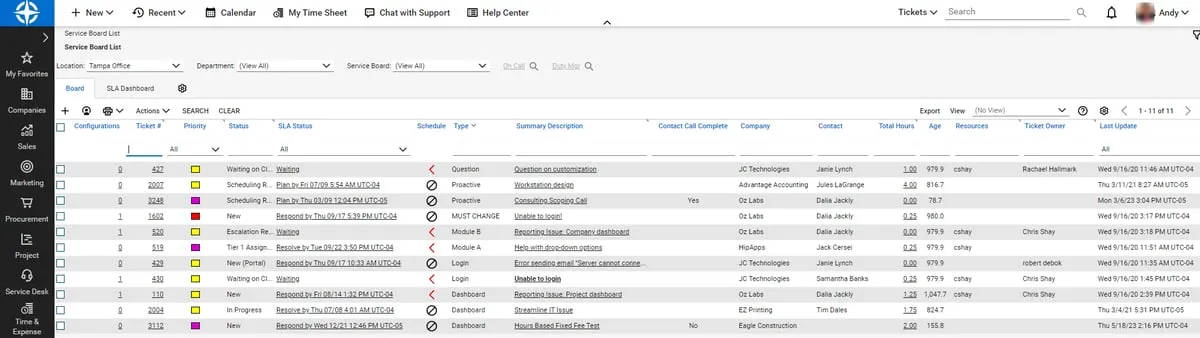
ConnectWise PSA (formerly ConnectWise Manage) is the market incumbent for a reason. Founded in 1982, ConnectWise has had four decades to build the deepest feature set in the category - service desk, project management, time tracking, billing, procurement, and CRM all under one roof.
The ConnectWise Asio platform bundles PSA with RMM, Automate, ScreenConnect, backup/DR, and security tools in what ConnectWise calls "the first true MSP platform." The shared data layer that ties these products together is the pitch - everything talks to everything else, which reduces the integration tax that plagues best-of-breed stacks.
ConnectWise Sidekick is the AI assistant layered on top, available via Microsoft Teams. It handles ticket triage, PSA record lookups, and common administrative tasks - less about ticket resolution, more about reducing clicks for the humans who are already there.
Where it falls short: The depth that makes ConnectWise powerful is also what makes it slow to learn and expensive to implement. The UI is complex. Onboarding takes weeks. Implementation partners charge thousands. Reddit's r/msp is full of shops that switched away to HaloPSA specifically because the overhead of maintaining a ConnectWise instance became a job in itself. Pricing also requires a sales conversation.
ConnectWise PSA pricing
Not publicly listed. ConnectWise requires a sales call for a quote. Expect pricing in the range of $65-$140+/user/month depending on bundle and contract length.
Verdict: ConnectWise PSA is the right call for MSPs with 50+ technicians who need every PSA capability available and have the bandwidth to administer it. For smaller shops, the overhead-to-output ratio often doesn't pencil out - HaloPSA or Syncro are usually a better fit.
4. HaloPSA
Best for: Mid-market MSPs that want deep customization without ConnectWise complexity
HaloPSA is what happens when a PSA is built for the 2020s instead of the 2000s. It holds 4.8-4.9 out of 5 across G2, Capterra, and Software Advice - among the highest in the PSA category - and is used by 5,000+ customers across 75+ countries.
The standout feature is the Actions engine - HaloPSA's automation primitive. Unlike simple trigger-based workflows, Actions chain together to build multi-step business logic: conditional billing, multi-tier approvals, SLA escalations, API calls. ConnectWise handles basic if-then logic; HaloPSA lets you model entire operational workflows inside the platform. For MSPs with complex internal processes, this is the capability gap that makes the switch.
The other advantage: pricing is fully published. No sales call required to do the math. At 20 agents, you're paying roughly $1,700/month - all features included, no add-ons or tiers. Native Microsoft CSP billing is built-in, which is a meaningful time-saver for Microsoft-heavy shops.
HaloPSA also committed to a 10+ year rolling independence pledge in 2023 - no acquisition, no PE fire-sale. For MSPs who've watched ConnectWise and Autotask ownership churn through the years, that's not nothing.
Where it falls short: You need a dedicated Halo admin for the first few months, especially for anything complex. Without someone owning the configuration, HaloPSA feels overwhelming. The 5-agent floor rules out solo techs and very small shops. Support is UK-based - slow for North American MSPs after 10 AM Pacific.
HaloPSA pricing
| Agent count | Price per agent/month |
|---|---|
| 5-9 | ~$109 |
| 10-24 | ~$85 |
| 25-49 | ~$69 |
| 50-99 | ~$55 |
| 150+ | ~$35 |
All features included at every tier. No hidden upsells. Implementation partners typically cost $5,000-$15,000 for a real mid-sized rollout.
Verdict: HaloPSA is the pick for 10-50 technician MSPs who want ConnectWise-level depth without ConnectWise-level implementation drag. If you can staff a Halo admin and sell Microsoft 365, it's a compelling option at a better price than most PSAs at comparable scale.
5. Syncro
Best for: Small to mid-sized MSPs wanting one clean bill for RMM + PSA + M365 security

Syncro is an all-in-one execution platform - RMM, PSA, ticketing, Microsoft 365 security, Entra ID identity management, and remote access (Splashtop) on a single per-technician bill. It picked up 19 G2 Winter 2026 badges including High Performer, Most Implementable, Best Results, and Best Estimated ROI.
The pricing model is the key differentiator: $179/tech/month on an annual contract, $209 month-to-month, unlimited endpoints at both tiers. No per-device fees. This makes Syncro predictable in a way that per-device tools never quite are - you can double the number of endpoints you manage without moving a pricing tier.
The M365 integration is deeper than most MSP platforms bother with. CIS-aligned security baselines, real-time configuration drift detection, Entra ID sync, and identity actions (password resets, MFA, session revoke, user block) are all built-in. For MSPs managing primarily Microsoft environments, this reduces the number of consoles you're logging into.
Where it falls short: Automation is solid but scripting-heavy - if you want no-code workflow orchestration, Syncro isn't as strong as HaloPSA or Rewst. The documentation module is useful for runbooks and SOPs but doesn't replace a dedicated tool like Hudu or IT Glue for client documentation.
Syncro pricing
| Plan | Price |
|---|---|
| Annual term | $179/tech/month |
| Month-to-month | $209/tech/month |
| M365 Cloud Backup add-on | +$1.90/user/month |
14-day free trial, no credit card.
Verdict: For MSPs with 3-30 technicians who want one consolidated platform without juggling multiple vendor contracts, Syncro is a very strong option. The pricing model is honest, the M365 depth is real, and the implementation time is short.
6. SuperOps
Best for: Modern MSPs who want AI-native architecture without legacy baggage

SuperOps is the cleanest expression of the "build AI-native from the ground up" thesis in the MSP software market. Where most platforms bolt AI onto existing architectures as features, SuperOps treats automation and intelligence as the structural layer the product is built on.
The platform ships as two products: SuperOps MSPSuite (for managed service providers) and SuperOps ITSuite (for in-house IT teams). The MSP version combines unified PSA-RMM with AI-driven service delivery automation, profitability management, and client management. The AI isn't a separate module you toggle on - it's threaded into ticket routing, device operations, and reporting.
This positioning is gaining traction with MSPs who started their businesses recently and have no legacy stack to migrate off of. They're not comparing SuperOps to ConnectWise as a replacement - they're building with SuperOps from the start because it fits how they think about operations.
Where it falls short: Community footprint is smaller than established platforms - fewer Reddit threads, fewer MSPs to ask for configuration advice, fewer third-party integrations tested at scale. SuperOps is still building the ecosystem depth that comes from years in market. Pricing isn't publicly disclosed, which requires a sales conversation before you can evaluate total cost.
SuperOps pricing
Not publicly listed. Contact SuperOps for a quote. Based on category positioning, expect pricing comparable to Atera and Syncro.
Verdict: SuperOps is the right consideration for MSPs who want to start fresh on modern architecture and aren't already deep in a legacy tool's ecosystem. If you're five years into ConnectWise, the switching cost is high. If you're starting a new MSP or evaluating your first platform, this deserves a real look.
7. Datto RMM
Best for: MSPs already running Autotask PSA or committed to the Kaseya ecosystem

Datto RMM is a cloud-native endpoint management platform with 4.5/5 on G2 from 700+ reviews and a strong track record on patch management and monitoring reliability. It runs on three regional data centers (US, Ireland, Sydney) with a 99.99% uptime SLA and BSIMM-validated security practices.
The clearest use case is the MSP that's already running Autotask PSA - the native integration between the two is genuinely tight, covering ticket creation, device-to-account relationships, and billing automation in ways that third-party integrations don't match. Datto also has deep Microsoft 365 management capability built in, which differentiates it from pure RMMs that treat M365 as an afterthought.
The ownership context matters here. Datto is owned by Kaseya, a conglomerate of IT tools acquired through private equity. That ownership has introduced three-year contract requirements and, per multiple Reddit threads in r/msp, sales friction and pricing opacity. The RMM product itself is solid. The customer relationship is where MSPs report friction.
Where it falls short: Development pace has slowed under Kaseya ownership per community feedback. Some automation and scripting features lag behind NinjaOne and N-able. Three-year contracts are a real commitment in a category that moves fast.
Datto RMM pricing
Not publicly listed. Request a quote from Datto. Expect enterprise pricing calibrated to endpoint count with multi-year contract requirements common.
Verdict: If you're already on Autotask, Datto RMM is the natural pairing - the integration depth justifies staying in the ecosystem. If you're evaluating from scratch, we'd run NinjaOne or Atera first before committing to the Kaseya stack.
8. N-able N-Central
Best for: Enterprise MSPs managing complex environments at scale

N-able N-Central is the choice for complex, large-scale MSP environments where power outweighs polish. It made the Gartner Magic Quadrant for Endpoint Management Tools in 2025, holds 4.3/5 on G2 from 348 reviews, and is running shops managing 1,800+ workstations and 500+ servers.
The AI layer is more sophisticated here than most: N-able ships four AI agents - Product Expert (console Q&A, 80% efficiency gains claimed), Asset Expert (device visibility), Security Expert (CVE prioritization), and an MCP Server for agent-to-agent automation. The drag-and-drop automation engine resolves around 50% of issues before users report them, per G2 community feedback. N-able also has an open 100+ integrations ecosystem that stays current with the broader security stack.
N-able's "Infinity Core" architecture is the pitch for power users - it's designed for environments where you need policy flexibility across hundreds of clients with different requirements, and you have the technical depth to configure it.
Where it falls short: The learning curve is real. Reddit's r/msp community consistently notes that N-Central rewards expertise and punishes shortcuts - and documentation gaps mean community forums are often more useful than official guides. Pricing requires a sales conversation. New users without dedicated admin bandwidth often struggle.
N-able N-Central pricing
Not publicly listed. Contact N-able for a quote. Per-device model with volume discounts; multi-year contracts available.
Verdict: N-Central is the right tool for MSPs that have the technical depth to unlock it - large shops running complex multi-client environments where scripting, automation policy, and Gartner-credentialed compliance matter. For sub-100 endpoint environments, the setup investment doesn't pay off quickly enough.
9. Rallied
Best for: Any MSP that wants to stop burning tech time on L1 tickets that a human shouldn't be touching

Here's the honest gap in every list above: they all organize work. Rallied closes it.
Most MSPs handle somewhere between 200-400 tickets per month that don't need a human - password resets, MFA unlocks, account unlocks, license requests, basic onboarding tasks. At 15 minutes each, that's 50-100 hours per month of tech time going into work that follows the same script every time. Rallied connects to your PSA, RMM, M365, identity system (Entra ID, Okta, JumpCloud, Google Workspace), and documentation (IT Glue, Hudu) and handles those tickets end-to-end: reads the ticket, executes the fix, notifies the user, closes the ticket. Your techs never see it.
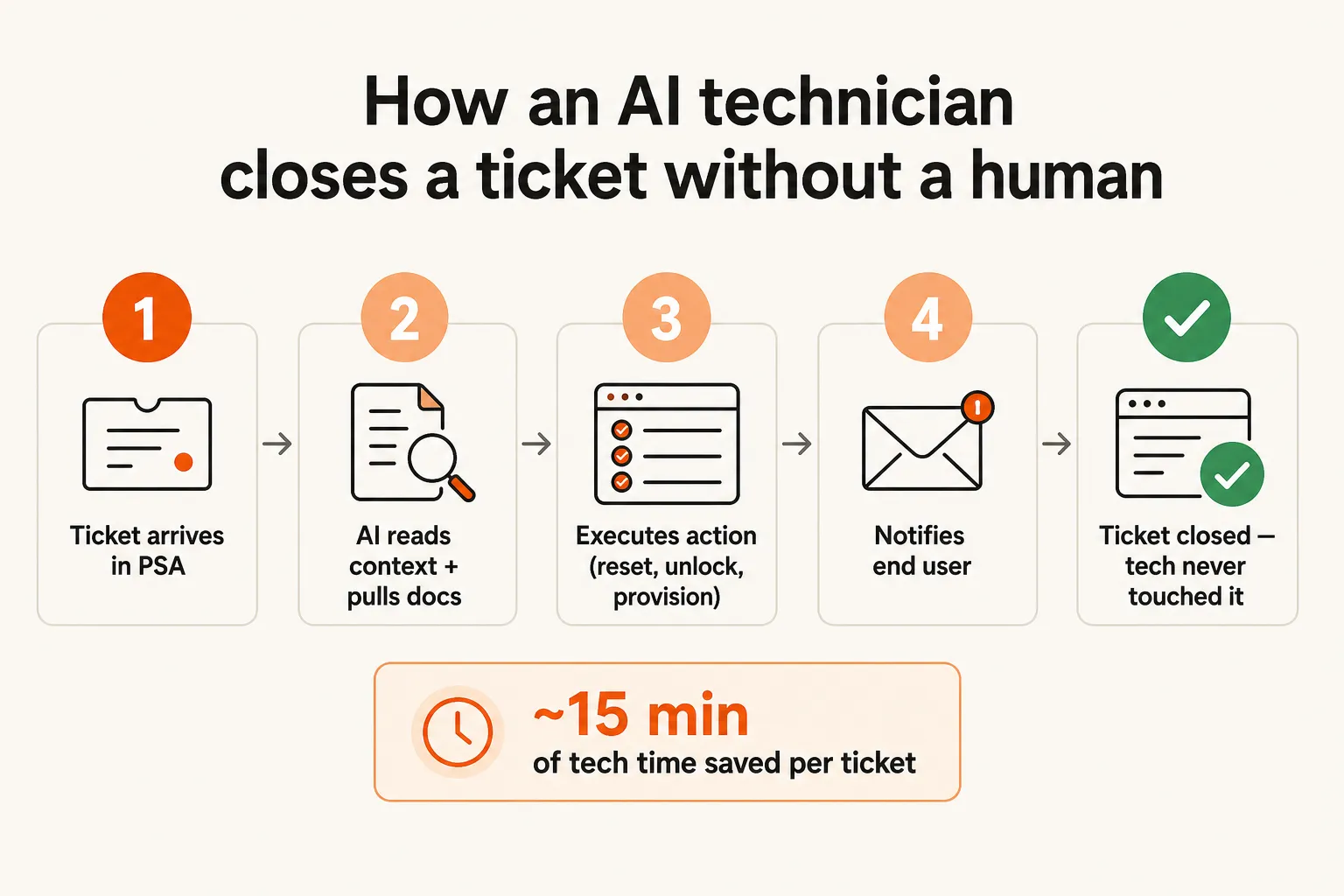
The difference from workflow tools like Rewst is execution depth. Rewst builds orchestration pipelines that techs still monitor. Rallied runs the actual action - password reset in M365, account provision in the PSA, group membership update in Entra ID. The distinction matters: one tool reduces clicks, the other eliminates the touchpoint entirely.
Deployment is same-week - no 6-month implementation, no dedicated admin requirement. The pricing model is pay-per-ticket: $0.50 each, or $0.40/ticket on annual. Voice triage (Rallied handles inbound L1 calls) runs the same rates per minute. A 14-day trial with $50 credit, no credit card required.
The ROI math is direct. 500 tickets/month at $0.50 = $250/month in Rallied costs. If the typical tech costs $150/hour of billed time and each ticket takes 15 minutes, that's $18.75 in labor per ticket - and Rallied replaces most of it for $0.50. Rallied's ROI calculator shows $7,500-$15,000/month in tech time returned for a shop running 50-100 automatable tickets monthly.
PSA integrations: ConnectWise, Autotask, Halo PSA, SuperOps. RMMs: Datto RMM, NinjaRMM. So whatever stack you're on from the list above, Rallied plugs in.
Where it falls short: Rallied is the AI resolution layer, not a PSA or RMM replacement. It handles L1/L2 autonomous work on top of your existing tools - if you're looking for an operational platform, you still need one. The product is also relatively new compared to the institutional names on this list, so less peer community to query. Spending caps and approval gates are configurable for anything that feels too automated to run without a human checkpoint.
Rallied pricing
| Type | Standard | Annual |
|---|---|---|
| Tickets | $0.50/ticket | $0.40/ticket |
| Voice (L1 calls) | $0.50/min | $0.40/min |
| Trial | 14 days, $50 credit | No card required |
Verdict: If your techs are spending meaningful hours on repeatable L1 work - and most MSPs are - Rallied is the highest-ROI line item available for under $500/month. It's not competing with NinjaOne or ConnectWise; it's the AI resolution layer that sits on top of them and makes the stack actually autonomous.
How to choose MSP software for your shop
The hardest thing about MSP software selection is that "best MSP software" is a category question masquerading as a product question. You need to know which layer of the stack you're filling.
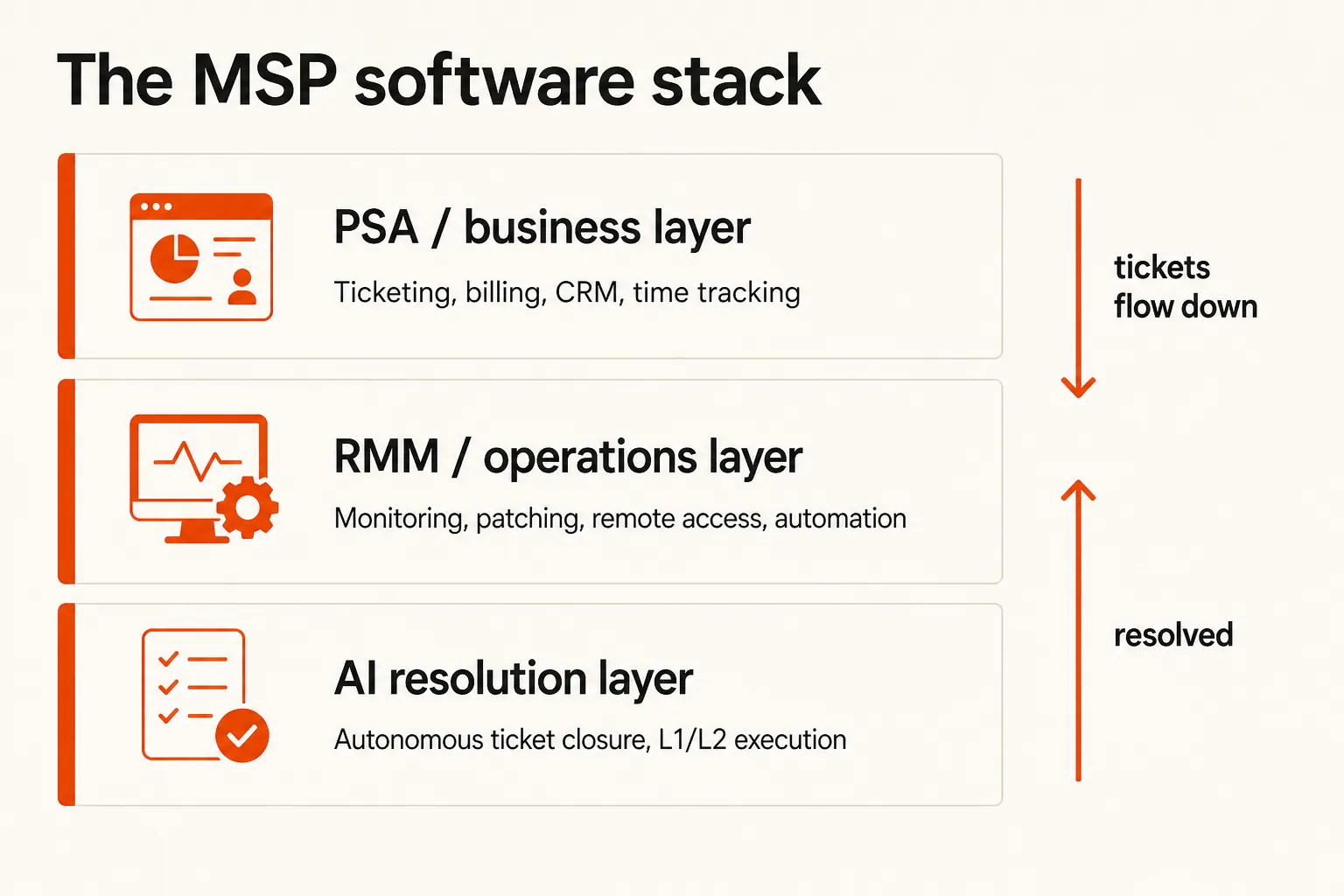
If you need a PSA: HaloPSA for mid-market shops that want customization and transparent pricing. ConnectWise for large enterprises already in the ecosystem. Avoid both if you're under 10 technicians - the overhead doesn't make sense.
If you need an RMM: NinjaOne if patch management is your north star and you're willing to pay for polish. N-able if you're running a complex enterprise environment and have the technical depth to configure it. Datto if you're already on Autotask.
If you want one bill for both: Atera for AI-native with per-tech pricing. Syncro for straightforward all-in-one with strong M365 integration. SuperOps if you're starting fresh and want modern architecture.
If you're already set up and want to recover L1 capacity: Rallied doesn't replace anything in the stack - it adds the resolution layer on top of whatever PSA and RMM you're running.
One pricing note worth understanding before you sign:
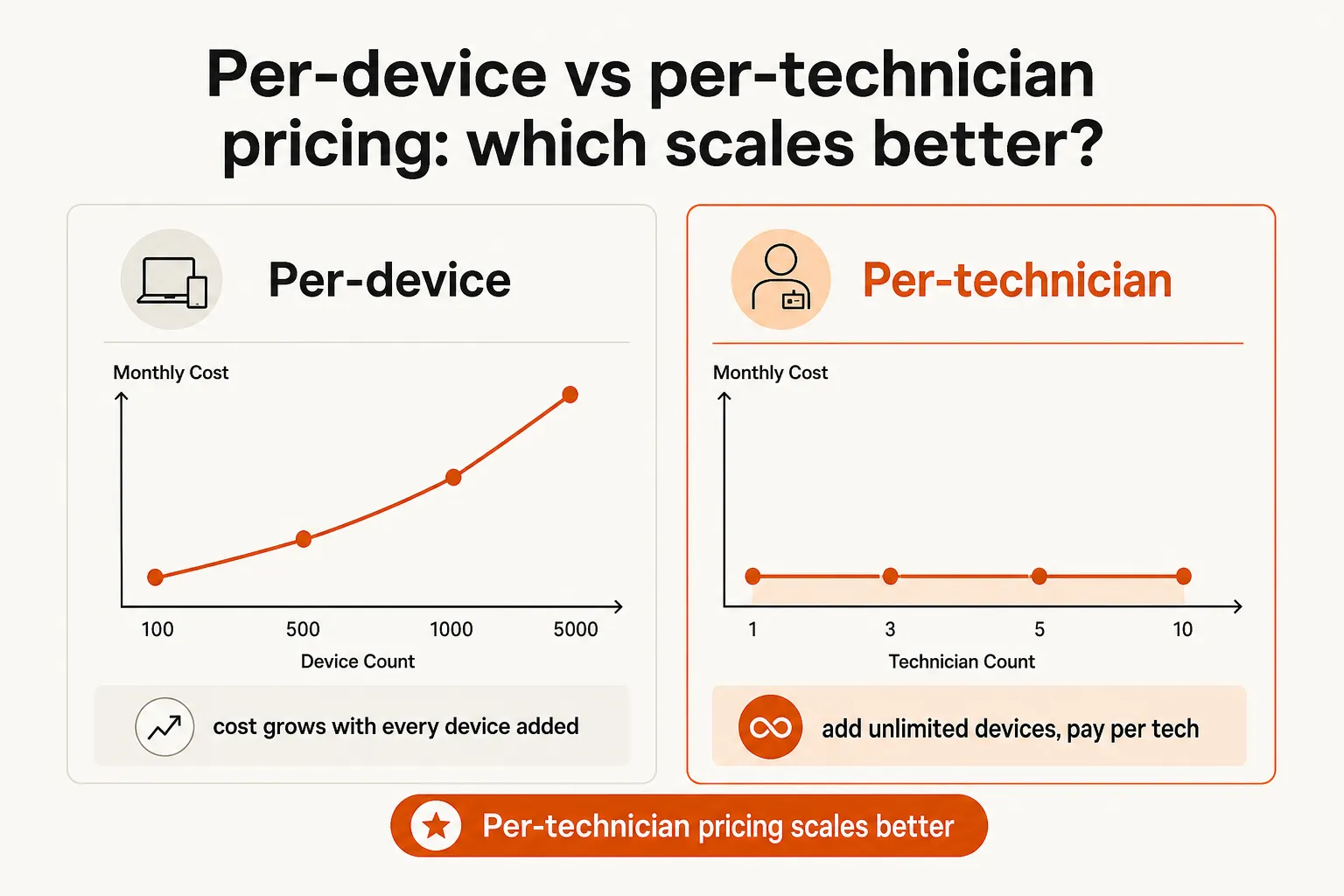
Per-device pricing (NinjaOne, Datto, N-able) scales linearly with your endpoint count. As you grow, so does the bill. Per-technician pricing (Atera, Syncro) decouples your tool cost from your endpoint footprint - add a thousand devices and your bill doesn't move until you hire another tech. For growth-stage MSPs, that model often wins on economics.
The honest version: no single tool covers everything. The MSPs running the most efficient operations in 2026 are running a solid all-in-one or PSA/RMM combo, layering a dedicated documentation tool (IT Glue or Hudu), and increasingly adding an AI resolution layer on top that handles the ticket volume no human should be touching anymore.
Try Rallied
Rallied is an AI technician built specifically for MSPs. It connects to your PSA (ConnectWise, Autotask, HaloPSA, SuperOps), RMM (Datto, NinjaOne), M365, identity system, and documentation - and handles L1/L2 tickets end-to-end without a human touching them. Password resets, account unlocks, onboarding, offboarding, phone triage.
The deployment story is the differentiator: same-week, no implementation fee, no dedicated admin requirement. The pricing is per-ticket - $0.50, or $0.40 on annual. A 14-day trial with $50 credit and no credit card. You'll know in two weeks whether the ROI pencils out.
Most of the tools on this list are great at organizing your work. Rallied is the one that makes some of that work disappear.
Start a free trial at rallied.ai
Frequently Asked Questions
What is the best MSP software in 2026?
The answer depends on what layer of the stack you're filling. For RMM, NinjaOne has held the #1 G2 spot for 23 consecutive quarters. For PSA, HaloPSA and ConnectWise PSA are the leading options. For an all-in-one platform, Atera and Syncro both offer RMM + PSA bundled at per-tech pricing. And for autonomous L1/L2 ticket resolution, Rallied is purpose-built for MSPs and deploys the same week.
What's the difference between PSA and RMM software for MSPs?
A PSA (Professional Services Automation) handles the business side - ticketing, billing, time tracking, client management, and SLAs. An RMM (Remote Monitoring and Management) handles the technical side - endpoint monitoring, patch management, remote access, and automation. Most MSPs run both, either as separate best-of-breed tools or as an all-in-one platform like Atera or Syncro that bundles both.
How much does MSP software cost?
It ranges widely by tool and pricing model. All-in-one platforms like Atera start at $149/technician/month with unlimited devices. Syncro starts at $179/tech/month. RMM-only tools like NinjaOne use per-device pricing starting around $3.75/device/month. PSA tools like HaloPSA start around $109/agent/month and scale down with volume. ConnectWise, Datto, and N-able require a sales call for pricing.
What MSP software do small MSPs use?
Smaller MSPs (1-10 technicians) typically lean toward all-in-one platforms to avoid managing multiple vendor contracts. Syncro and Atera are both strong choices - both offer per-tech pricing with unlimited devices, which keeps costs predictable as your client base grows. SuperOps is also gaining traction with modern MSPs starting out in 2025-2026.
Can AI software actually close MSP tickets without a technician?
Yes - and it's one of the most underused tools in the MSP stack. Rallied connects to your PSA, RMM, M365, and identity systems and autonomously resolves L1 and L2 tickets - password resets, account unlocks, onboarding, offboarding, and more. It deploys in the same week with no implementation fee and costs $0.50 per resolved ticket. A typical MSP running 200-400 L1 tickets per month can recover 50-100 hours of tech time monthly.